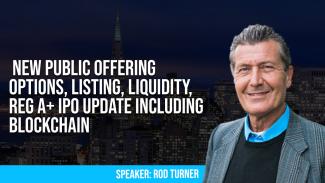
Use the Chapters list below to select the part of the video you want to watch.
Chapters:
- Webinar Agenda Overview
- Introduction to Rod Turner & Manhattan Street Capital
- Legal Disclaimer
- BOXABL's Success with Reg A+
- What’s New with BOXABL? | Regulatory Strategies and Interpretations
- Investor Incentives: How BOXABL Boosted Participation
- Lessons from BOXABL: What Could’ve Been Done Better?
- Q&A – Share Price Discounts and Warrants as Investor Incentives?
- Q&A – Addressing Dilution & Fairness Concerns for Existing Shareholders
- Q&A – How Can a Company Raise So Much with Negative EBITDA?
- Key Metrics from the Newsmax Reg A+ 75 Million NYSE IPO
- What's Unique About the Newsmax Offering?
- What Could Newsmax Have Improved in Their Offering?
- Q&A – Did BOXABL or Newsmax Disclose Their Pre-Money Valuation?
- Q&A – Did Newsmax Use a Direct Listing Model?
- Q&A – Pros and Cons of Reg A+ Compared to Reg D?
- Q&A – Update us on Crypto and Blockchain Offerings via Reg A+
- Q&A – Impact of BOXABL & Newsmax on Offering Strategies and Budgeting
- Reg A+ Rule Changes & Broker-Dealer Participation
- Broker-Dealers Are No Longer Needed for Texas and Florida!
- Using a Broker Brings FINRA Involvement Which Makes Marketing Your Reg A+ More Difficult and Slows it Down
- Brokers Add Cost and You Must Still Spend Big on Advertising. That's Too Expensive.
- Q&A – What Types Of Companies Are Likely To Succeed with Reg A+?
- Final Thoughts & Wrap-Up
Special thanks to Ryan Ellenburg and Chris Werner for their comments on their experience working with Broker-Dealers:
"Facebook/Meta Pixels have certain requirements to enable tracking and surprisingly, most of the big boys in the industry do not support creating the infrastructure to facilitate this. What's even worse is that there doesn't seem to be an interest in supporting this. Rod, however, without even pushing back, saw the opportunity to improve on this and enabled his platform to incorporate all Pixel tracking, and his team even followed up to confirm sales were logged and tracked on the Meta Ads Manager. MSC provides top-shelf infrastructure along with boutique-level customer service." - Ryan Ellenburg, Capital Markets Associate, GolfSuites Reg A+
"At C3 Bullion, we found that our broker-dealer caused us significant problems with our Reg A+ offering. The broker-dealer was excessively restrictive in what it would allow us to say on the investment offering page and in our marketing. They placed numerous limits on how we could describe the investment, making our offering appear vanilla and dull compared to the reality of what we do. The broker told us they had no choice, that FINRA required them to limit what we could say. This significantly increased the cost of our marketing efforts. Now we know, from Manhattan Street Capital, that we don't need a broker-dealer. Wish we had known that 18 months ago!" - Chris Werner, CEO, C3 Bullion
"The way they (the broker-dealer) treated our marketing content was too restrictive. We always knew they wouldn't bring clients, but we never expected them to block our marketing efforts. Even the way they handled international clients was too much. They became our business prevention unit. Next time, I would NOT use a BD from the beginning. What I would do is start WITHOUT a broker dealer, build some momentum, raise some capital, and then decide if to add a BD or not, and if the decision was to partner with a BD, the decision needs to be based on the capabilities and business friendlines of the BD, the BD cannot become the business prevention unit of your business as it became to us." - Chris Werner, CEO, C3 Bullion
MSC is not a law firm, valuation service, underwriter, broker-dealer, or Title III crowdfunding portal and we do not engage in any activities requiring any such registration. We do not provide advice on investments. MSC does not structure transactions. Do not interpret any advice from MSC staff as a replacement for advice from service providers in these professions.
(1).jpg)
Rod Turner
Rod Turner is the founder and CEO of Manhattan Street Capital, the #1 Growth Capital service for mature startups and mid-sized companies to raise capital using Regulation A+. Turner has played a key role in building successful companies including Symantec/Norton (SYMC), Ashton Tate, MicroPort, Knowledge Adventure, and more. He is an experienced investor who has built a Venture Capital business (Irvine Ventures) and has made angel and mezzanine investments in companies such as Bloom, Amyris (AMRS), Ask Jeeves, and eASIC.
www.ManhattanStreetCapital.com
Manhattan Street Capital, 5694 Mission Center Rd, Suite 602-468, San Diego, CA 92108.
Related Content:
How much does a Regulation S offering cost?
Timeline for a Reg S offering
Timeline for a Reg D/Reg S STO via convertible notes
THIS TEXT TRANSCRIPT HAS ERRORS IN IT THAT WERE CAUSED BY THE SPEECH-TO-TEXT CONVERSION SOFTWARE WE USED. DO NOT DEPEND ON THE TEXT TO BE ACCURATE. WATCH THE RELEVANT PARTS OF THE VIDEO TO MAKE SURE YOU ARE PROPERLY INFORMED. DO NOT DEPEND ON THIS TEXT TRANSCRIPTION TO BE ACCURATE OR REFLECTIVE OF THE STATEMENTS OR INTENT OF THE PRESENTERS.
Hello and welcome, everybody.
And I need, yeah, everyone's muted, right? That's already done. Let me just give me a thumbs up on that ferry or Akos to make sure that all the attendees are muted so we don't lose the video stream.
So the topics, we have three broad topics today. We'll be talking about the success of Boxables, Reg A+, and no Reg Ds for that matter.
We'll be talking about their success, raising money in order to learn the new learning from that. We'll talk about the Newsmax IPO.
They actually went to the New York Stock Exchange, our earlier email outreach about Newsmax We'll go So talk about that as well and lessons to be learned from that experience.
And I'm also going to talk about, in the third section, about new developments in the use of broker-dealers in Reg A+ offerings.
In particular, there's some significant changes that have taken place that really, you make for, you know, more efficient offerings.
And we'll get into that as the third topic. And in this, because each of these topics is kind of free self-standing or free-standing, I'm going to have a short Q&A session after each one of these topics.
So after Boxable, there'll be a short Q&A, and after the Newsmax, there'll be a short Q&A, and the same thing after the broker-dealer update.
Okay, so that's the approach we're going to take. Thank Welcome. I'm glad to have you here with us today.
I hope that you will find this a very informative and worthwhile use of your time. Thank you to Ákos and Feri on my team for the work they've done and are doing in hosting this webinar and will be doing in terms of delivering the content after the session and then getting everyone here by sending out the invitations.
Thanks, Feri. Thank you, Ákos. My background is that, it's probably obvious I'm from England, I started my career as an electrical engineer on a nuclear power station in the UK, and then I moved over to computers in the UK, and then I moved to this country to get better weather and more opportunity, moved to California, and then soon thereafter, a year and a half after I arrived, I joined my first startup, which was a company called
Ashton Tate, the maker of D-Base 2, the publisher of D-Base 2, 3, and so forth. And I became the first vice president of that company.
I was the 12th employee at Ashton Tate. We went public a long, long time ago, 1983, November of 1983.
And we became the third largest microcomputer software company in the world then, in the early 80s, early, mid-80s. Then I moved on to Symantec, the makers of Norton Antivirus, and numerous other products.
In the early days, a product called Q&A, Questions and Answers Database with a natural language system. Way back, running on 286 microcomputers and doing natural language querying then, if you can imagine that.
Anyway, so then I've gone on, I've built seven successful startup companies, had a couple of failed startups along the way.
All of these high-tech and framework too, Andrew, yeah. going Framework was a tremendous piece of software, that's right. That was 83, 84, 84 when we shipped it.
So I've had a lot of good fortune in building successful high-tech startup companies. I launched Manhattan Street Capital 10 years ago because of Reg A+, actually, because the SEC was under pressure from the then-current government to make online investing feasible, and it's fair to say that they were dragged into it kicking and screaming and really weren't enthused about that.
But they did, it took them a while, but they did come up with a few methods of raising capital online, and Reg A+, to me, is by far the most pragmatic and attractive one of those options.
So I launched this company because I was looking around for something interesting to do. It leverages my skills, and we can do, you know, we are doing and we can do a lot of good with Reg A+, both in providing great companies
These access to capital they might not have been able to easily raise, or to liquidity that might have been more difficult, public offerings and so forth, major listings, and also to investors, so investors have access to great companies that are poised to do really well or are already doing really well.
That's why I launched Manhattan Street Capital. I like the way Reg A Plus was written. It's pragmatically written. A legal disclaimer.
We are not broker-dealers. Please check in the chat box. There is a legal disclaimer there. Please read that. We're not a law firm.
We're not underwriters. We're not broker-dealers. We're not valuation professionals. We are not investment advisors. I am literally providing this guidance to CEOs and CFOs of companies and founders of companies, so you can figure out how best to navigate the capital raising and the public offering.
... And, obviously, selfishly, so we are indirectly promoting Manhattan Street Capital, so some of the great companies will come to us, as you guys do.
I recommend that you select Speaker View in your Zoom call, which is a button on Windows, it's in the top right.
But if you select Speaker View, then you'll see whoever's speaking, which, until the Q&A, most of the time, will just be me today.
But there may be a couple of times where others will speak. You are welcome to post questions in the chat box, in the Zoom chat box, at any time.
I would prefer it if you group them according to the session we're in. So, the first session is boxable, the second will be Newsmax, the third will be new developments in the broker-dealer field.
As to, you know, we'll get to those. I would prefer it that you group your... Questions by some topic, but in any case, put your questions in the Q&A, and when the opportunities arise, I will do my best to answer the questions that I can add value to in the most effective manner, and in the order in which they're posted according to the fact that I can actually answer them in useful way.
And again, we are recording this webinar, and we will be creating a YouTube video version of it, a blog post with it, and a clickable index into that blog post, so this could easily, sometimes these webinars go to an hour and 15, an hour and 20 minutes, I think this one will be a little shorter, but in any case, when you're confronted with a video that's that long, you don't want to watch the whole thing, you just want to watch the relevant parts, and the clickable index makes that easy for you.
So we'll also edit out errors, if there are any, before we produce that, and they'll go out in about a week's time, to everyone who attended and those who booked.
to attend this webinar, and again, please don't record the session because there may be errors in it and I don't want to get us into regulatory hot water.
So the agenda is first to review learning from, learnings we can gather from the successes that BOXABLEl has had, especially recently because they've done some things that are different in their Reg A Pluses.
Then we'll move on to the Newsmax IPO to the New York Stock Exchange via Reg A Plus and we'll learn from it and gather that data.
And then we'll move on to new developments in the use of broker dealers in Reg A Plus and the downsides of broker dealer involvement and the FINRA regulator.
Those are the agenda items as already advertised. So, I'm starting off withBOXABLE. BOXABLEl has in the past three years done a number of Reg A
Greg+, and Reg D offerings, they have raised approximately $168 million in online capital formation so far, mostly via Reg A+, they've done about $3 million in Reg CF, and the balance in Reg D offerings, but mostly in Reg A+.
Their most recent Reg A+, which finished a few weeks ago, raised $75 million in the maximum, and it was very successful, and we'll get into how in a moment.
Their past offerings, they tended to sell preferred shares, especially in the Reg Ds, and in their recent rounds, which were combining of a Reg D and a Reg A+, they offered common only.
They have about 30,000 investors in total, including Reg D offerings, and an average, including the Reg Ds, of about...
$5,600 per investor, and you can imagine, you know, if you play that forward, that would typically turn out to be an average of about $2,000 per, or $2,000 $3,000 in Reg A+, and significantly higher with the smaller numbers in the Reg D side.
So, what's new about Boxable, what I think matters to you guys, are the following items. It's been, you know the way it is when you're dealing with the regulators, I mean, a powerful regulator like the SEC, in some instances, they make, they provide great clarity by publishing regulations in immense clarity, and we know where we stand.
In other cases, they don't provide that clarity, and they leave us guessing, right? So, I see many examples of that, you know, when you talk to three or four different securities attorneys, and you get different answers.
And they're each confident. That's a great example where there's interpretation going on. And it's unfortunate, but that's the way life is, right?
So if I wind back the clock, I've been doing this, I've almost Manhattan Street Capital 10 years and three months ago, going back in that time, up until very recently, when I would ask a securities attorney about combining a Reg D with a Reg A+, they would place these hurdles in front of me.
They would say these are the restrictions. One, that the SEC will combine the amount that you raise in the Reg D with the amount that you raise in the Reg A+.
So if you have a maximum of 75 mil in your Reg A+, and you raise 30 mil in your Reg D, then you can only do 45 million in the Reg A+.
That's called integration when they're considering both as one. It turns out. It if you conduct these offerings carefully, the SEC does not do that.
They don't integrate them and there is no limit on how much money you can raise in a parallel... Simultaneous Reg D with your Reg A+, that's point number one, right?
Point number two is that I was also told, reliably, repeatedly, over many years, that if you're doing a Reg D and a Reg A+, in parallel, that you must offer the same terms, the same share price in the Reg D to avoid problems with the SEC.
Obviously, there's some degree of litigation risk in anything you do in life, but with the proper disclaimers, that wouldn't be the issue, although there's a tiny amount of risk there.
The primary thing I was told, though, is, yeah, can't do that, as far as the SEC is concerned. That was securities attorneys who were experts interpreting what they believed the SEC would react to.
What's emerged is that, so this is an emerging practice, so the observation of what the SEC allows in Reg A+, has evolved differently, in that they allow deep discounts.
To volume investors in the Reg D, whilst offering a Reg A+, right? So, in the case of Boxable, they're offering up to 75% discount to large volume investors, they were, up until they closed their D and their A+, recently.
They were offering up to 75% off the Reg A+, share price to people who put in very large amounts of money via Reg D.
So, this morning, somebody might invest $2,000 in the Reg A+, at a share price of, I don't have the numbers in front of me, let's say it's $10 in the Reg A+, this afternoon, somebody puts in a huge sum of money via Reg D, they might be paying $2.50 for the same shares, right?
So, obviously, this motivates institutions and other wealthy investors to put up larger sums of money in the Reg D.
So, And it opens up opportunities that didn't exist before, right? I mean, there were instances in the past where companies were doing Reg A Pluses, and institutions would turn away because the maximum was too low to give space for them to get in, or because they wanted better terms than the Reg A Plus offered and that Main Street investors could get with a $300 or $400 investment.
So now that's been turned on its head by the practice, the emerging practice or the emerged practice of the SEC.
That presents a lot of opportunity. Inboxable, to their credit, took serious advantage of that. It's another thing which has emerged in Reg A Plus is that the SEC, again, without stating it overtly, they've always allowed the use of investment incentives.
You know, if you invest more money, $10,000 via Reg A Plus, that was a 75. The question there from David was, was that discount a 75% discount?
So... 25% discount, right, so $2.50 price per share, when this morning somebody invested at $10 a share, giving, you know, using the example I just gave.
Pretty amazing. Now, that was like $100 million investment in a Reg D, so you're not going to get many, right?
But that's the, that was the, that was actually the fact in the BOXABLE deal. But another thing which has emerged is that the SEC, they've always allowed people to say, hey, if you invest $10,000 in my Reg A+, then I'll, then you have dinner with the CEO, or you'll get a special tour of the, of the facilities, or you'll come up and, we'll take you for a test flight in our latest new airplane, something of that rewards, as it's been used, have been used in things like Kickstarter for a long time.
But what evolved there, as a practice, is the SEC will allow companies to provide lowered prices in a Reg A+, via bonus share.
There's gifting bonus shares to people who invest larger sums. So there's still only one current share price in a Reg A+, one share price at any point in time, but that share price can be discounted effectively by giving up to 20% discount via bonus shares, and you can have multiple tiers, right?
And we built into our investment platform the ability to track all of this automatically, and also to track it cumulatively, right?
So somebody who's invested in this case, $10,000 being the hurdle, say, for a 20% discount, somebody who's invested $15,000, when they go to invest again, we can prompt them, we have in our platform, we can prompt them that if they invest more than $5,000, it'll push them above $10,000, and then they'll get a bunch of free shares, which they wouldn't get if they only invested $4,000, right?
So very motivating to track it cumulatively. To my knowledge, no one else is doing that. We do that. in our investment platform already through our payment processing system.
It's pretty slick software, it's not rocket science, but nobody else is doing that to my knowledge. So offering those bonuses on a single investment basis is pretty easy.
Offering them on a cumulative basis where we track everything that's happened so far for each investor is more difficult, and we do that as well.
Okay, so let me see the other things, new and boxable. I mentioned no integration, right? So again, I was being told, no, no, no, if you, you know, if you, 75 mil is the max, it's the cap.
If you did your Reg A+, and the cap was 30 mil, and you add in a Reg D simultaneously, then you capped it 30 mil with the two combined.
And that is no longer the case, as long as you navigate and communicate about those two offerings in the proper manner.
And there's a method to that, which we obviously know, to avoid integration. And I would say, yeah, those are the important things.
Those are the important things. So So Well, yeah, I can show you that. I'll come back to the questions later.
I don't want to interrupt my flow too much. I'll come back to them at the end of each section.
What could Boxable have improved in their offerings? I told you our software handles cumulative tracking of multiple price levels.
That's a really good thing which they couldn't get through the service providers they were using. And the other thing that we do is we elegantly handle multiple different pricing tiers in a Reg D and multiple different bonus share tiers in a Reg A Plus through our investment software in a way that is easy to understand and doesn't require a whole bunch of manual work.
And again, what Boxable was struggling with, they were using DealMaker. Nothing wrong with DealMaker per se, but there's a bunch of things they don't do that would be nice to do, which we do like that, right?
We would... Tracking cumulative investments, and we're automatically displaying the different pricing tiers in a Reg D and bonus share tiers in a Reg A+, in an elegant, simple-to-understand manner during the investment process, rather than having it be manual, lots and lots of after-the-fact work, trying to figure it out, which is so difficult, and puts off investors, you know, on a common, commonly puts off investors unless you're at the point where you're finishing a giant successful round, which Boxable was.
So, towards the end, investors would jump through hoops. Another thing that we could improve on with Boxable is if they'd used our payment processing systems, they would reduce their cost of payment processing fees by 50 or 60%.
And the other thing they could do is not pay broker-dealer commissions, because the broker-dealers, in this case deal-maker, wasn't adding any value.
They weren't bringing in investors, but they were charging sizable commissions, so save that money. Those are things they could have done differently.
So now... I'm going to take questions on BoxaWall before I move on. Is the incentive warrants? No, you can provide warrants in a Reg D or a Reg A+, obviously, I don't know, if it isn't, I mean, maybe it's not obvious.
It's not always the best thing in a Reg A+, because many investors don't understand warrants, and so you don't want to create too much confusion for your audience of investors.
And if it's an audience of Main Street investors that we're able to easily reach through social media advertising, you don't want to confuse them to where they say, yeah, you know, I'm not sure about the warrants, I'll come back and study this.
And then their wife calls them in for coffee or tea or something, and they don't continue. You don't want to have that happen.
So avoiding confusion in the process is important, although you can use warrants. And Raj asked, is there a demo he can see?
Yes, yes, I can do that. But we need to arrange it directly, Raj. David says, up. With all the discounting, there any concerns about shared dilution and fairness to other shareholders?
Of course, and that needs to be provided for in any anti-dilution provisions that investors have to protect them, right?
So, these things, anything you do needs to be done in a fair and balanced manner, and it would be silly.
We're doing an offering now, where we're doing a Reg D and a Reg A Plus soon for a very lovely biotech company, and they're offering discounts in their Reg D and in their Reg A Plus of the type we're discussing here, by the methods we're discussing here, and they made clear that the anti-dilution provisions, which they're selling preferred shares, which these preferred share investors get, do not apply to other investors who invested in this round.
So, the discount tiers they're providing don't cause dilution protection issues, and that's a reasonable thing to do, but it, and
It has to be spelled out. So, Patrick says, I'd expect 1 to 5% of dilution per round with all the bonus shares.
Yeah, you can, of course, you can limit it. You can state in the Reg A Plus Offering Circular that there's a finite capacity of bonus shares, and when it's used up, it's used up, right?
Or you can set a maximum and say, we'll no longer go on offering bonus shares once we have achieved $28 million of capital.
or raised, something of that ilk. You can do things of that type. Alan's asking IPO timing. Well, the company that I didn't disclose, they, actually, you're asking about Boxable.
I don't know their IPO timing. They made a lot of, they marketed aggressively about their plans to do an IPO without announcing the when of it, because they're not allowed to, in a Reg A Plus, announce their predicted timing, right?
They're not allowed to forecast that. They're They did go and get a NASDAQ stock ticker, which is promising and exciting.
You know, it doesn't cost much, if anything, to get that, but that was a smart move on their part.
Don't know when it's going to happen. Then Brad says, how does a company Liveboxer will raise so much money when they have a loss on EBITDA?
Well, you know, what happens, Brad, is that if you're doing something relevant that's exciting, timely, which they are. know, they're making prefabricated homes at low cost, which are more robust than many regularly constructed homes.
And there's, you know, with various climate change scenarios and burn-out scenarios and so forth, that we've been way too conscious of in recent years, that increases interest in their products.
Although, you're right, their actual revenues and the actual number of homes they've delivered, I guess it's about 600 or 800 homes delivered.
It's time. Andy, relative to their valuation, which is very high, but, you know, when you have generated enough success by good marketing of a company that is appealing, that success begets more success, and raising the share price from time to time makes people motivated to get in whilst they're going as good, as it were.
And Patrick says, $15 million on advertising. Yeah, I don't know how much they spent, but given that they've raised $168 million via Reg D, Reg A+, primarily, and a little bit via Reg CF, you know, it's not unreasonable to have spent $15 million on advertising.
I don't know how much they've spent. That wouldn't be out of the way. 10%, a little bit less than 10%, would not be unreasonable.
I expect it's lower than that. But certainly, in recent times, the amount they've had to spend has been reduced, because they've been getting close to the end of each of their raises, so.
A lot of people spectate until the last possible minute. Okay, I'm now going to move on to Newsmax. So, this might have passed under the radar with you because Newsmax went public in March and it wasn't stated publicly everywhere in the easy-to-see media.
It wasn't obvious that it was a Reg A+, but when I saw that it was a 75 million IPO, I said, okay, you know, you don't pick 75 million.
It's a cap on an S1. Why would you do that? So, I checked and obviously it was a Reg A+, IPO.
So, now I'm going to tell you the metrics of what they have done with their public offering and then I'll get into the how part around that also.
So, they did a Reg D in February of $225 million for preferred shares, which converted into common and did convert into common when the IPO listing occurred.
That's not unusual to do that. The timing was very... They did this via an online 506C Reg D offering, and they provided a discount in that Reg D of 25% below the initial planned offering price for their Reg A+, which was not yet qualified.
So they stated their intended initial valuation of $1.2 billion for the Reg A+, and then they set a valuation of $900 million as 25% discount for their Reg D.
And they set out a goal of $150 million with the option to extend it, and they were oversubscribed and raised $225 million in that Reg D in February of this year.
And then when they were qualified in March, they went live and raised $75 million in a matter of weeks, three weeks, via Reg A+, in an online raise through retail investors.
They have about 30,000 Reg A+, investors. A+, and Put in an average of $2,500 each. The minimum investment amount was $500 per investment.
The Reg D brought in about 8,000 investors who put in an average of about $28,000 each. These are sort of normal numbers you would reasonably expect to see.
And except for the discount in the Reg D, which preceded, in this case, the Reg A+, there were no other discounts, no bonus shares.
They weren't needed. Newsmax is the fourth largest news media company. They have a huge audience. I think 40 million people see TV coverage, streaming TV and other video coverage from Newsmax every month.
With an audience of that scale, then Reg A+, is a marvellous instrument to raise money, and to go public with, as they did, and to raise money via Reg D also, as they've evidenced, right?
They're in a very strong situation. I'll get into more about that. They advertised their own investment offering, and you can imagine it was very inexpensive because of the scale of their audience, and politically, know, a large following, good timing for them as well.
Yeah, motivated audience, large audience, very, very easy for a media company with that scale of audience to market themselves to raise money via Reg A+, whereas if they were in an S1, they would be in a quiet period, no marketing allowed, right?
Can't do anything unusual, can't make unusual announcements, no marketing allowed. So, an S1, for Newsmax, they should be allergic to an S1, they should be loving a Reg A+, and I imagine they did love it because they've had immense success with it.
So, just to review what's new in the Newsmax deal. Excuse me, I'm getting a call. I'm getting a call.
I will reject that. Yes, pardon me. So, what's new? Newsmax's IPO and their capital raises both show how incredibly great Reg A Plus is as an IPO instrument.
The cost of filing the Reg A Plus is tiny compared to an S1. The amount of time it takes to get qualified by the SEC is remarkably short compared to an S1.
The audit costs are lower or can be. They probably did PCAOB audits up front because they knew they were going to take this route.
So, they didn't save money on their audits. But the ability to promote their own offering versus having an acquired period in an S1 is immense for a company that has a large audience.
What Newsmax is rather an extreme case, but it's a beautiful demonstration of how Reg A+, can be a marvelous instrument, and is frankly extremely powerful and useful for IPOs, for companies that have a sizable audience, and there's quite a few of them.
It's not everybody, but for the companies that fit, it's superb. Lower cost, much faster, and you can raise unlimited amounts via the Reg D, and then do up to 75 mil in your Reg A+.
The other important thing, I'm a little biased, like my company isn't a broker-dealer or an underwriter, we can partner with and have partnered with underwriters to do and assist with Reg A+, IPOs in the past.
There haven't been too many of those offerings recently. Excuse me. I'm getting too many calls coming in. The point here is that you can also do a direct listing via Reg A+.
G. And... The NASDAQ or to the New York Stock Exchange, and that would save you so much money because now you're not spending eight or so percent in underwriter commissions and you're not spending the upfront fees to the underwriter and you're not paying FINRA to involve an underwriter or a broker dealer.
don't need to. If you have a following of scale, and I know Newsmax is rather an extreme case, if you have a following of scale, then you can do it direct.
You can do your own direct listing, and that can be a marvelous thing, which has another benefit, which is that unlike, you know, when you're in a market where the underwriters are essentially saying, the market's closed, the market window is closed, that means that they can't comfortably easily raise money in their expectation, and so there are many times companies cannot get traction with underwriters, but you can do a direct listing anyway, right?
So if you have the audience, then this online capital formation method, then the sequence There's a Reg D, then Reg A plus is a superb way to go, in my opinion.
What could they improve and what could they have done differently in their sequence? They could have saved the underwriter fees by using Manhattan Street Capital because they had the marketing cloud, which is where the biggest risk lies in doing an online raise.
They could have done a direct listing, and again, you don't have to have an underwriter involved, so you save the underwriter fee.
And, you know, there's another one, another example where the SEC hasn't made a clear statement, but there's emerging practice, is the use of QR codes.
So imagine if during the Reg A plus offering and the Reg D offering from Newsmax, they used QR codes in every video story that they did.
So, 40 million people seeing their news coverage, and all of them seeing a QR code, some of them experimenting by scanning the QR code and clicking through.
Now they're looking at an investment offering, 40 million people per month, beautiful thing to do. The SEC was asked a year or two ago, they were asked to overtly state that QR codes were fine, because up until that time, the overt statement was you could have a clickable link.
So Billboard ads weren't right, weren't okay, and mostly TV wasn't okay, because how could you have a clickable link unless it's streaming online TV?
So the SEC was asked that. The SEC did not choose to make an overt statement. They left it ambiguous.
So I see some companies choosing to use QR codes successfully and doing so without grief, and I see some securities attorneys vetoing that.
So this is another example of a gray zone. But if you do it properly, QR codes are a marvelous way to go.
So we helped Cub Crafters do a Reg A+ a couple of years ago, very successful offering, lovely company. They did a deal with...
With Red Bull, where a stunt pilot took one of the Cub Crafters planes, modified it a little bit, lightened it a little bit, and landed on the Old Bears building in Dubai, which on a helicopter pad, and took off from that same helicopter pad, using a Cub Crafters airplane.
Red Bull promoted that, and they got over 1.6 billion views, I think, of the various videos that they produced.
Had Cub Crafters got permission to include a QR code to their Reg A Plus investment offering, that would have been free marketing, virtually.
That would have been a lovely thing. So, QR codes would be a wonderful thing to include. Now, I'm going to refer, of course, yeah, Carl is saying Reg D shares cannot be sold to unaccredited investors, of course, that's a known fact, right?
That's not a new statement. I wasn't saying that you can raise money from unaccredited investors in a Reg D.
You must absolutely not do so. That's a 506C, unlike a 506B, you have to actually verify the accredited status of all the investors in a Reg D 506C, which is what Newsmax used, as is appropriate.
If you're broadly marketing a raise, you can only use Reg D 506C. That's the only instrument that the SEC allows to be used in that way.
Okay, so I'm going to see the other questions. Oh, okay, fair enough, Carl. He's saying, I was answering a question that he was answering someone else in the chat.
Carl says, is it true BOXABLE or the Newsmax both said nothing or little about their pre-money valuation? I actually haven't studied that.
I believe they both disclosed that. And it's always included either. Directly or indirectly in the Reg A-Plus filing, I would prefer in a Reg A-Plus Offering Circular, which is a Form 1A when you file it with the SEC, I would prefer that the valuation was staged overtly, because the way the filing works, you have to actually figure it out by looking at the number of shares outstanding, but it's common practice to state the pre-money valuation, and I believe they did, but I was not auditing that.
Terry says, so Newsmax, did they direct list their shares on those exchanges? They listed on the New York Stock Exchange, the main exchange, via an IPO, because they paid the commissions and used an underwriter.
The underwriter did not use a broker-dealer network to market the offering, they did it all online, the same we do at Manhattan Street Capital.
So they made a sizable commission with very little outgoing effort on that race. It was a blessing for the big time
They didn’t do a direct listing for Newsmax or for Boxble would be entirely possible. Boxable hasn't done that yet. They still can. Newsmax could have done that and save themselves a lot of money. So Bar says: Lets say I have a live broadcast company, 45 million top line revenue, 10 million earnings. Would a rollup strategy acquiring a couple of smaller companies to bring into the fold be attractive in the IPO world? All told 60 million top level and 20 million earnings yes yes you might be able to market raise money successfully the company as it is um depending on the nature of the scale and of the audience and how happy that audience is but doing a roll-up would of course make it more attractive as a strategy and commercially as a viable enterprise and
If you can do an unlimited raise via Reg A, why do a Reg D? Yeah, if you can do an unlimited via Reg D, because it's easier to raise money via Reg A plus, William.
Reg D, it's easier in the sense that you don't ask permission from the SEC. You file a Form D to notify them, but you don't have to ask permission, so it's quicker.
You're allowed to make predictions. You're allowed to state the expected internal rate of return in a Reg D, which you can't do in a Reg A plus.
Other limitations of that type apply in Reg A plus. But Main Street investors are much easier to market to, because they don't have so many options, so many marvelous companies beating a path to their door, asking them to invest.
And they tend to act more emotionally. If a company is doing something that they care about, that they believe is going to improve their quality of life, Main Street investors are more likely to invest.
So the cost of acquisition of investment in that case. Is much higher, you know, you can't take a boring company, it's hard to explain and market it via, even if financially it's attractive, via Reg A+, in almost all cases, if it's financially attractive, you can still do that in a Reg D if you can get their attention.
Reg D investors, accredited investors, have many, many choices, of course. Okay, going on down the list. Steven says, how do you incorporate your platform with tokenized platforms like Polymath?
So, at the moment, that's a really good question because the SEC is a fast-changing puppy at the moment, right?
They've been, for the last seven or eight years, extremely anti-crypto. So, anything to do with it has been penalized and you couldn't have, you had almost no chance, actually in recent years, no chance of getting a crypto company to do a Reg A+, and virtually no chance to do an S1.
Some exceptions, retrospectively, but in more recent They're now having to do a U-Term because of President Trump's approach and because of the new leader of the SEC taking a pro-crypto approach and the new regulatory environment we see.
So it's going to be less restrictive. At the moment, if we were to file a Reg A-Plus with a client talking about accepting crypto investments, they would almost certainly be vetoed based upon recent history with the SEC.
I imagine that that is going to change soon. So in a Reg D or a Reg S scenario, Reg S being an international equivalent in some ways to Reg D for non-US companies and non-US investors, then we can process crypto payments into those companies via platforms like Polymath if they're prepared to play ball with us.
What my experience is that many of the crypto payment processing companies are paranoid for what is now historical reasons about doing anything in the U.S.
to do with investment offering. So it's really difficult. It's to get people to play ball. We used to have, 2017, 2018, when the ICO boom occurred, we had a Bitcoin payment processing system and we were able to accept investments in Reg D via Ethereum, but the debt got shuffled, that Bitcoin company got bought out by another and they stopped doing it in the U.S., they do it outside the U.S., so it's a bit of a lean time at the moment, but that will change, so watch this space.
Okay, Carl says, how's the BOXABLEl and Newsmax offerings changed my perspective on offering strategies and marketing budgets? It's changed in the sense that it re-energized my enthusiasm for doing real IPOs via Reg A+, and direct listings, particularly via Reg A+, because for the right companies, this is a no-brainer, so much better than an S1.
Literally, I've done, as a part of the management, top management The team of Ashton Tate and of Symantec, I was part of both those companies when we went public, and in each case, we had a six-month quiet period prior to doing our S1 IPO, where we couldn't even start doing more press announcements and talk about our company more aggressively than we could in the past, even if we didn't talk about a capital raise, because that's the way it is in an S1.
The Reg A+, is the precise opposite, right? You have to market it, you're allowed to market it, it's perfectly okay.
So, for a company that has a sizable audience, and these days, you know, of course, there's a number of companies that have a great audience, Reg A+, is so much better than an S1 IPO.
I love that. That, for me, is huge. The discounting of shares in a Reg D to reward institutional engagement and other wealthy investors to engage, versus, you know, it's too expensive and I want a better deal than someone can get for putting in $1,000.
That, we're... Starting four years ago, we started to see institutional interest and participation, but providing seriously advantageous terms through Reg D, in parallel with the Reg A+, makes it possible to raise much larger amounts of money cost effectively, which I, of course, love.
I don't know. I don't remember the price per share, Alan. I'm not sure. Actually, in the case of Newsmax, I do know it was $10 a share.
I've got a couple of other metrics on Newsmax. They, their share price was $10. They went out at about $28.
They ran up to $265, 700% increase in share price in a few days post listing. Now they're down at about $13.
So it's still positive relative to the issue price. Obviously, that comes down to fundamentals, you know, the profit and loss and revenue stream of the company and how well a good a job they're doing.
Marketing themselves ongoing. Yeah, Steven mentions the Genius Act. Obviously, the passage of the Genius Act is making crypto much more attractive, right?
The fact that we now have ETFs for Bitcoin, ETFs for Ethereum and more coming, and the fact that we have the endorsement, effectively, through the Genius Act of stablecoins, huge, huge for crypto.
So we're going to see tremendous leaps in the crypto area that have been blocked for many years. So I'm really pleased to see the U.S.
getting back in properly into this game and doing it in a way that can work very well. And obviously, that affects the ability.
It makes it easier for us to raise money when people who have made money in crypto can invest that crypto directly into our company's offerings.
So I'm pleased about that as well. I believe Republic is already off. Offering Investments via USDC, it's, I believe you're probably right, Patrick, when you say that, that's good to hear.
I hear DealMaker will follow shortly, well, we'll follow shortly too, you know, we're not doing it today, but we'll follow shortly.
Yeah, so Dr. Hai is promoting his offering. Send me an email at rodturner at manhattanstreetcapital.com. Feri, please put my email in the chat box so people can grab it.
How long does it take, on average, for a regular plus offering to be authorized by the SEC? So, we've had about six of our clients get qualified by the SEC in two weeks.
Two weeks, because they were uncontroversial, they were well prepared by service providers like us that are well known, and so good stuff.
You should never expect that it'll be so quick. The SEC SEC says they're staying. It is an overt statement that you file with a complete filing, they give themselves a month before they get back to you with comments and questions.
You respond to those comments and questions, and they give themselves a month for the second round. They normally get back to you in two weeks on the second round, even though their commitment is a month.
So the average Reg A Plus qualification process is average, 45 days. There are some exceptions. We had a lovely company that was a market maker for Bitcoin, and this was during a time that the SEC was getting more and more restrictive on crypto, and it took forever.
And finally, the company gave up because the SEC just made life too miserable. But normally speaking, two weeks is wonderful, and it can happen.
We've had it happen, as I said, six times. And more commonly, you know, allow two months and don't expect anything.
You know, you have to deliver. And of course, everything has to be filed properly. Okay, now I've got to move on quickly, reasonably quickly.
Schedule here. The next section is an update on changes in Reg A+, related to broker-dealers. Broker-dealers have their place.
Underwriters have a really wonderful place when you're doing an IPO, obviously. And broker-dealers have their place, too, no question about that.
A big change in Reg A+, though, as it affects broker-dealers, is that three years ago, two years ago, it was a pain getting into Texas and Florida and a couple of other states, but Texas and Florida in particular.
So, in theory, our clients could file with Texas and Florida as their own broker for their own offering and get permission and do the Reg A+, without having any broker-dealer involvement.
But, it was slow and difficult and time-consuming, and Florida had a... they didn't like Reg A+, and they had a shortage of staff in their securities department.
So, it was a pain. That was the most cost-effective method. Most companies... It to add a broker dealer just to get into Texas and Florida and a few other states that made it difficult where you could still work with them and get through relatively easily.
Lots of people invest from Texas and Florida. So that was the case. And I have on my platform, on my company's platform, we've got FAQs talking about this issue and informing companies about the problem states and how to solve that problem.
Two things, two big things have changed, actually more than two, but the biggest ones are Texas has become much more proactive about stock offerings and stock exchanges.
They're enticing the NASDAQ and the NYSE to open exchanges in Texas. And I presume that's the reason they've made it easier now, where they still require you to file, but you can file immediately.
On the same day you file your Reg A Plus with the SEC, you can file that day and they'll typically get you approved within four weeks in Texas.
So that's become a beautiful, smooth journey. And Florida changed their regulations. Where you no longer need to get their permission and file as your own broker-dealer, you no longer need a broker-dealer to raise money in Florida, so you save an immense amount of money, you don't have to pay the FINRA fee on filing, where that's dependent on how much you're raising, I think it's a 1% fee, you don't have to pay that, you don't have to pay upfront fees to a broker-dealer, you don't have to pay commissions of 2%, 3%, 4% to broker-dealers that aren't raising money for you.
So, it's a part, I'm getting distracted by stuff being posted in the chat section, so now it's much easier to raise money in a REG A+, with no broker-dealer involvement, save the FINRA fee, save the broker fees and commissions, and more importantly, this isn't new, but it's significant, I want you guys to be aware that the problem with having a broker-dealer involved in a REG A+, is that they are regulated by FINRA, and FINRA is
Very slow bureaucracy and very restrictive on broker-dealer activities. the broker-dealers, depending on how they interpret the rules and depending on their relationship with FINRA, they place very tight restrictions on the marketing content, on your offering page for your REG A+, and on the email content that you can send out, and on the advertising content that you can send out.
Highly restrictive stuff, punitive in many cases. So, not only are you spending money, you're losing the ability to cost-effectively market your REG.
That's a huge issue. Huge. The other thing is that when you include in your REG A+, filing that you have a broker-dealer involved, then you make provisions for that, describe it, and so forth, as you would expect.
The SEC then, when they're ready, let's say they qualify you in two weeks, which is a lovely scenario when it happens.
Whatever time they qualify you, they will not actually qualify you until FINRA blesses your DEA. with the broker dealer.
And we've had situations where that stretched out for months and months, and the client finally gave up, cancelled the broker dealer arrangement, and lost out on the cash fees they'd already paid, removed the broker dealer references from their Reg A+, and then got qualified by the way once they made that refiling.
So my point here is that there are so many Reg A Pluses that get caught in jeopardy by having FINRA involved by dint of having a broker dealer involved, it costs months and months and months in many cases, in which case you're sitting on your hands waiting to raise money and, you know, not able to do so.
So those are serious reasons why not to use a broker dealer. Again, you know, I know a lot of great broker dealers and underwriters, good rapport with many of them, and like to work with them, etc.
But, you know, now you can do a Reg A Plus with my company and with other platforms without having to spend an heinous amount of money in commissions and fees.
Thank you much. Now, there's a couple of our companies that we know and work with who have posted, volunteered to give us feedback, which I posted in chat.
We have posted in chat. One is from a company called C3 Bullion, and the other is from GolfSuites, and I don't know if Ryan is on with us, but Ryan is the guy that runs marketing for GolfSuites.
They've done a number of Reg A+. They did their first one with us, and they came back to us to do their most recent one with us, having gone elsewhere for a while.
So they have very, he has very relevant experience. So I'm thinking the first of the two quotes is from Ryan.
Let me just check here. Yeah, so please make a note of that. We will be including those quotes in our blog post article when we send it out.
So you'll have access to it, to them there. Small print, difficult find. Okay, so now I'm opening up to questions on the broker-dealer topic, and in general on the whole webinar, and on Reg A+, and on Reg D for that matter.
I hope this has already been useful, but if you have questions, please do post them. And so you're aware, actually I'm going to go scroll back up and see if I'm missing questions that have already been posted.
Yeah, Carl is promoting his book there, yeah, talked about qualification, yeah. The biggest issue, really, with doing a Reg A+, is that it costs an arm and a leg to market an offering.
In most cases, if you don't have a gigantic audience of people that love your company, then the biggest expense in online capital formation is advertising outreach through typically Facebook, Instagram, and in some cases TikTok, because if you could get into TikTok...
It's the most efficient, the most cost efficient vehicle, they have the best AI. But, you know, that is the most expensive piece of everything.
If you have a broker dealer charging you 6, 8, 9, whatever, 6, 7, 8% commissions, you're still having to do all the advertising because in an online offering at Reg D or Reg A+, broker dealers will not raise the money for you until and unless it's already a successful offering.
Then is when they will kick in, but you have to bring in the first 10 or 20 million to make clear that it's a success.
Do so quickly, do so efficiently. Then is when engaging a broker dealer can make sense because that is when they'll take a risk and bring in their clients to invest.
Top management in a broker dealer may say, yeah, yeah, we love it, we'll do this. But the reps who work for the broker dealer do not want to put their client relationships at risk on an offering that is as yet unproven.
So they're not going to do the proving, we have to do the proving, we have to conduct the marketing together.
To make it successful. Andrew says, when is my company suitable for Reg A+. Andrew, it all comes down to the nature and scale of the appeal.
The market you're serving, are the trends, are the strategic shifts in your market favourable to your company and your strategy?
Is what you do easy to explain? Can it easily be marketed online? Is it appealing? Does it seem to people that it will improve their lives?
Do you then all the obvious things like, do you have a strong team? Are you addressing a large enough market to be worth addressing?
Are you uniquely capable of addressing that market? Do you have sizable barriers to entry? It is nothing to do with how many employees you have.
And if you have 10 or 20 years of audited financials, those can be lovely. But if it's, you know, as an example of a company that shouldn't do a Reg A+, a company approached me three years ago that had that had revenues of about 50 million.
We were 3% profit, 2% or 3% growth per annum. In a boring business that's hard to explain, they really were insistent on going public on the NASDAQ via Reg A+, and I had to repeatedly tell them that much as I like them and their enthusiasm, we shouldn't do this because you can't raise money for that company.
Boring, slow growth, difficult to explain, and low profitability. So if you have the opposite of that, exciting, great growth potential, you don't have to have revenues, you have to have a market that's really , and many AI companies fit the bill right now, of course, you know, it goes without saying, but it does depend on the specifics.
So Alan says, yeah, he's advertising his Wall Street research, which is a good vehicle. I endorse Alan. Well, you know, I don't recommend you go use him instead of working with my company, but Alan's good at helping get exposure.
Okay, so I'm going to give you some wrap-up comments here. Thank you all for your participation. I hope you found this a worthwhile discussion.
As I said earlier, we have recorded this session. We will create a video version of it, a recorded version, with a clickable index, so you can just click to the part you want to see.
Obviously, at this point, we're about an hour, so the video will be about an hour in duration. And we'll probably subdivide it into three separate videos, one for each segment, because these are three separate segments, aren't they?
So we'll do that separately. But initially, in about a week, 10 days, you'll be getting a link in order that you can click on.
It will take you to the video blog post with all this content in it, so you can refer it to it, look at the bits that matter most to you, and you can share it to your friends and so forth.
That's about it for me, I guess. So, I thank you for your attention, and again, hope that you found this worthwhile, and if you have questions, my email is in the chat box, you're welcome to email me, and you can come to the Manhattan Street Capital site and click on Contact Us and email us through that too, I'll see that.
Yeah, thank you for the thank yous being posted. Yeah, there you go, and Andrew's going to use D-Base right on.
So, thanks again, guys. I'm going to move to wrap in a moment here, and yeah, we'll include most of the questions in the video as well.
All right, thank you very much, everybody. You have a great rest of the day, rest of the week, and bon voyage in building your businesses and in successfully raising capital for your business.
Ciao, ciao. All right, bye, guys. bye. Bye, bye. All right, bye. you.
THIS TEXT TRANSCRIPT HAS ERRORS IN IT THAT WERE CAUSED BY THE SPEECH-TO-TEXT CONVERSION SOFTWARE WE USED. DO NOT DEPEND ON THE TEXT TO BE ACCURATE. WATCH THE RELEVANT PARTS OF THE VIDEO TO MAKE SURE YOU ARE PROPERLY INFORMED. DO NOT DEPEND ON THIS TEXT TRANSCRIPTION TO BE ACCURATE OR REFLECTIVE OF THE STATEMENTS OR INTENT OF THE PRESENTERS.