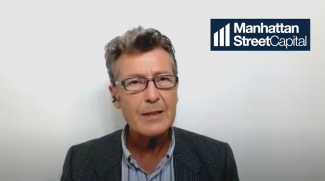
I'm Rod Turner, founder and CEO of Manhattan Street Capital. I've spent decades in the capital markets (including taking two companies public on NASDAQ) and I've watched the rules of investor discovery change multiple times.
What's happening right now with AI search is the biggest shift by far. And most founders raising capital today are missing out.
The Real Problem: You're Probably Not There At All
Here's what's actually happening. A serious investor hears about your sector (maybe they're actively looking for a Reg A+ offering in your space). They open ChatGPT, Claude, or Gemini and ask a straightforward question: "Which companies are currently raising capital in the EV sector?" or "What are the best Reg A+ offerings in biotech right now?"
Your company doesn't come up. Not because the AI said something wrong about you. Because the AI said nothing about you at all.
That's the problem most founders aren't thinking about. They're worried about bad press, about negative search results, about what Google ranks on page one. But the more urgent issue (right now, today) is that AI answer engines are becoming the first stop for investor discovery, and most growth-stage companies raising capital have zero presence in them. They're simply not in the room when the conversation happens.
This is not a fringe behavior. Sophisticated investors (accredited individuals, allocators, family offices) are increasingly using AI as a research starting point. They ask it questions. They get answers. And if your company isn't part of those answers, you don't get a second chance, because you never got a first one.
Perhaps most importantly, Google itself is rapidly switching from the “old” search method to AI search using Gemini. This is causing a huge shift across the whole Internet. Make sure you adapt quickly.
Why AI Search Works Differently From Regular Google Search
For the past twenty years, showing up for investors online meant optimizing for search engines. Keywords, backlinks, content volume. That still matters. But AI search operates on entirely different logic, and the gap between companies that understand this and companies that don't is growing fast.
The new discipline is called Generative Engine Optimization (GEO), and it changes the game in a specific way.
When someone Googles your company name, Google finds pages that match those words and ranks them. When someone asks ChatGPT, Claude, or Gemini a research question about your sector, the AI doesn't look for pages. It looks for facts it can confidently synthesize into an answer. It draws on everything it has been trained on and everything it can retrieve: SEC filings, news coverage, analyst commentary, LinkedIn data, trade publications, community discussions, and reference sources.
If you have a thin, scattered, or inconsistent presence across those sources, the AI simply won't have enough confidence to include you in its answer. It's not that it dismisses you. It's that it doesn't have the material to work with. So it reaches for the companies that have given it more to go on, and those are the companies that show up.
The founders who are winning in AI search right now are not necessarily the ones with the best companies. They're the ones who have built the deepest, most consistent, most authoritative digital footprint across the specific surfaces that AI models actually draw from.
Where You Need to Show Up, And Why
This is the practical part. If you want AI answer engines to include your company when investors ask relevant questions, you need to be present and substantive in the places those engines actually look. Here's where that is:
Wikipedia (company page and founder page). Let me be direct about this one: Wikipedia is one of the most heavily cited sources across all three major AI engines, and having a well-sourced page for both your company and your founder can make a significant difference in whether you show up in AI-generated answers. However, getting a Wikipedia page is genuinely not easy. Wikipedia has strict notability requirements, and pages without sufficient credible third-party sourcing get deleted quickly. You cannot simply write one and publish it. You need a meaningful body of coverage from reputable outlets first (think mainstream financial press, established trade publications, verified news sources) before a Wikipedia page will stick. This is one more reason why building your PR presence early matters. The Wikipedia page is the reward for having done the groundwork, not a shortcut around it. If you can get there, the AI visibility payoff is substantial.
Reddit. This one surprises a lot of founders, but Reddit threads are appearing with notable frequency in AI-generated answers, particularly when investors are asking research questions about sectors, companies, or founders. Subreddits focused on investing (r/investing, r/SecurityAnalysis, r/RegA, r/startups and others relevant to your sector) are actively crawled and referenced by AI models. Being discussed there, in an informed and positive context, adds a layer of community validation that AI models treat as a signal of real-world relevance. You can't manufacture this, but you can participate genuinely, answer questions in your area of expertise, and make sure your company is being represented accurately in relevant discussions.
Quora. Similarly, Quora answers from founders and executives are showing up consistently in AI search results, particularly for question-based queries. If an investor asks an AI "What are the biggest challenges of raising capital via Reg A+?" and there's a detailed, well-written Quora answer from a credible founder in that space, that answer gets cited. Writing substantive, expert-level answers on Quora about your sector, your technology, or the capital raising process (rather than just promoting your company directly) builds the kind of attributed expertise that AI models recognize and surface.
LinkedIn (your company page and your founders' profiles). AI models treat LinkedIn as a credible source for team backgrounds, company descriptions, and operating history. Thin LinkedIn profiles, or profiles that don't match what's in your filing, are a gap that works against you. Fill them out. Keep them current. Make sure your founder profiles tell a clear, compelling story about track record and relevant experience, because that's often the first thing an investor asks AI to summarize.
Your company website (especially the About and IR pages). These need to be substantive, not just marketing copy. AI models look for concrete facts: founding date, headquarters, what the company actually does, who's on the team, what stage you're at. Vague brand language doesn't give the AI anything to work with. Write for clarity, not just for style.
Press releases and news distribution. Every press release you've issued is out there being indexed. Regular press releases (announcing milestones, funding progress, partnerships, product developments) are one of the most reliable ways to build the kind of consistent, dated, factual record that AI models draw from when constructing answers. If you haven't issued one in three months, that's worth addressing.
Reputable financial and trade publications. A single well-placed mention in a credible finance or industry outlet carries more weight with AI models than a dozen self-published blog posts. This is where PR investment pays real dividends in the AI search era, not for vanity, but because it creates the kind of third-party validation that AI models are specifically designed to prioritize. One good article in the right publication can meaningfully shift how AI answers questions about your sector. It also feeds the sourcing requirements for Wikipedia, which makes it doubly valuable.
YouTube and video content. If you've done webinars, pitch presentations, or investor Q&As that are publicly accessible, AI can reference them. They add to the body of evidence that your company is real, active, and worth citing. More importantly, video content that addresses investor questions directly (your business model, your market opportunity, your team's background) gives AI models specific, retrievable facts that static web pages often don't. With Youtube it is a huge advantage in Google AI search.
Investor relations content on your own site. A dedicated IR section (with a clear company overview, a FAQ for potential investors, and regular updates) gives AI models a structured, reliable place to pull facts from. Think of it as writing directly for the algorithm as much as for the human reader. Short paragraphs, clear headers, specific numbers, plain language.
The pattern here is straightforward: the more substantive, consistent, and current your presence is across these surfaces, the more material the AI has to work with, and the more likely it is to include you when an investor asks a relevant question.
What Investors Are Actually Asking AI Right Now
It helps to think concretely about the questions being asked, because that shapes the strategy.
Investors using AI for capital raise discovery are asking things like: "Which Reg A+ offerings in the cleantech space have revenue and a verified team?" or "What growth-stage companies are raising capital in the defense technology sector?" or "Which founders raising on Reg A+ platforms have prior exits?"
These are not searches for your company by name. These are category-level research queries, the kind of question someone asks before they even know which companies to look at. If your company doesn't show up in response to questions like these, you are invisible at the most important stage of the investor journey: before they've even started narrowing their options.
Getting found at this stage requires having a presence that is not just accurate but substantive enough that AI models can confidently place you in a category, describe what makes you distinctive, and include you in a curated answer alongside other relevant companies.
That takes deliberate work. It doesn't happen by accident.
What to Do About It, Starting Now
Pull up ChatGPT, Claude, and Gemini (all three) and ask each one the question an investor in your sector would ask. Not your company name. The category question: "Which companies are raising capital in [your sector] via Reg A+?" See if you come up. Then search your company name directly and read what each engine returns.
Do this across all three. They pull from different sources and weigh them differently, so you may get meaningfully different results from each one. Where you're missing, that's where to focus.
Then work through the list above systematically. Fill the gaps. Publish regularly. Build the record that gives AI models the material to include you. Freshness matters too. AI engines show a real preference for recent data. A company that publishes consistent updates signals activity and credibility. One that's been quiet for six months signals the opposite.
The Reality Check
None of this replaces strong fundamentals. A company with an unclear value proposition or a team without a track record won't be saved by a GEO strategy. But a well-run company with a compelling raise can absolutely be overlooked simply because it hasn't built the digital presence AI models need to find it and include it.
That's the gap worth closing. And the good news is that closing it is largely within your control.
At Manhattan Street Capital, we work with the companies we help to make sure they're positioned effectively across every surface that matters, for human investors and for AI alike. We coordinate with marketing agencies, help structure investor communications, and make sure the full picture of a company's raise is being told consistently and visibly across the channels that drive real results.
As always, these observations come from a marketing and platform perspective. Manhattan Street Capital is not a law firm, valuation service, underwriter, or broker-dealer. Your legal and financial advisors should guide the substance of your offering and your disclosures.
Let's Talk About Your Raise
If you're a founder at the growth stage (working through Reg A+, Reg D, or the path toward a public offering) and you want to make sure your company is actually showing up when the right investors go looking, reach out. And if we can help you succeed with your capital raise - just let me know by replying to this email.
Email me at [email protected] and tell me about your company, your sector, and where you are in your raise. The investors are out there, and they're asking AI to help them find you. Let's make sure it can!
(1).jpg)
Rod Turner
Rod Turner is the founder and CEO of Manhattan Street Capital, the #1 Growth Capital service for mature startups and mid-sized companies to raise capital using Regulation A+. Turner has played a key role in building successful companies including Symantec/Norton (SYMC), Ashton Tate, MicroPort, Knowledge Adventure, and more. He is an experienced investor who has built a Venture Capital business (Irvine Ventures) and has made angel and mezzanine investments in companies such as Bloom, Amyris (AMRS), Ask Jeeves, and eASIC.
www.ManhattanStreetCapital.com
Manhattan Street Capital, 5694 Mission Center Rd, Suite 602-468, San Diego, CA 92108.